
Ant Treatments $20 OFF
Carpenter Ant Treatments
Guaranteed Colony Elimination
For carpenter ant control we use a safe, low toxicity odorless treatment to prevent or eliminate carpenter ant infestations. Our carpenter ant treatment not only eliminates the carpenter ants you are seeing, it also eliminates the hidden carpenter ant nests in your walls. This is where the real damage is occuring. Note: To best prevent a carpenter ant re-infestation, a carpenter ant treatment should be done on an annual basis before May 20th. After the middle of May, homes that are located within the 300ft. range of an outside carpenter ant colony might already be re-infested. This is because the carpenter ant workers might have already hollowed out some new wood in your home to move the newly developing larvae into. Besides individual carpenter ant treatments, we offer annual service plans that schedule their spring-time preventative treatments before this important date
Carpenter Ants
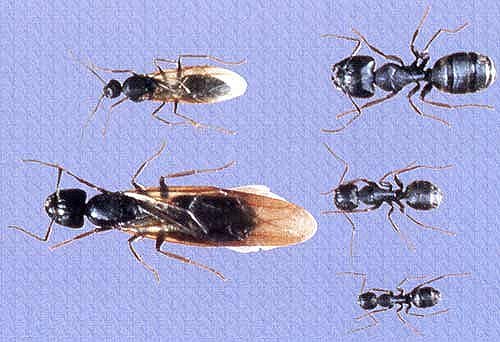
 The most common ant in the New England area which causes home owners to seek professional help is the Carpenter Ant (Camponotus spp.) They are the most noticeable of ants in and around the home being large and usually blackish, perhaps with some faintly grayish bands on the abdomen. Other carpenter ants may have some reddish or purplish coloration to the thorax (middle body part). Foraging workers have large mandibles which can give a powerful bite. They vary greatly in size, depending on their function, from 1/4 to 1/2 inch (minor workers), 1/2 to 3/4 inch major workers and 3/4 to 1 inch long winged reproductives. Most carpenter ants seen inside your home are the wingless minor workers that make up most of the colony. They are black medium sized ants. Carpenter ants can cause serious damage to wood by excavating galleries, which somewhat resembles the work of termites but can be distinguished by their very clean sandpapered appearance. Sawdust or wood shavings known as frass found in and around the home is usually an indication of a nest being excavated nearby, but very often it goes unnoticed because the wood shavings are being deposited inside your walls. Carpenter ants do not eat wood, but they rip it apart with their front mandibles for nesting. Moisture is a desirable condition for ant colonies, and wood which has been water damaged is a prime target for new nests, although perfectly dry and sound wood is also excavated. Galleries are cut with the wood grain and major workers then carry the developing larvae from the outside nest (around 30,000 ants) to the new satellite colonies in nearby homes. These secondary nests can have up to 3,000 workers.
Click Picture to Watch Video
Large Carpenter Ant Colony
We Found in a Customer’s House
Carpenter Ant Damage
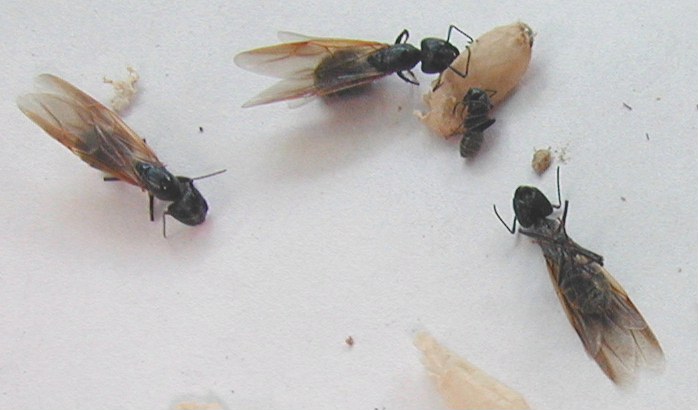
The most susceptible areas of your home to carpenter ant damage are where decks connect to your home, window sills, corner exterior sections and under any doorways. They can however be found almost anywhere in the house. Once inside the home, ants can quickly travel along water pipes and create satellite colonies in walls and upper levels going undetected until the nest reaches maturity. When this happens, not only is wood being destroyed, but on the first warm day in spring, the nest blossoms and hundreds of ants can come pouring out into your home, prompting a frantic phone call for HELP to someone like Security Pest Elimination! Regularly seeing carpenter ants in your home is a good indication that there is a nest somewhere in the wood structure and carpenter ant damage is happening nearby. Seeing winged swarmers is a definite sign of a nest because carpenter ant swarmers do not forage for food, but leave a mature nest only to mate and start a new colony. If you live within 300 feet of an outside carpenter ant nest your home will be under siege on an annual basis from these ants. They will move their developing larvae every year from the main nest into your home. To prevent them from doing this your home needs to be treated every year. This way the first round of scouts will die and the colony will not select your home for a satellite colony that year. Timely annual Preventative Treatments are a must if you wish to protect your home from carpenter ant damage.
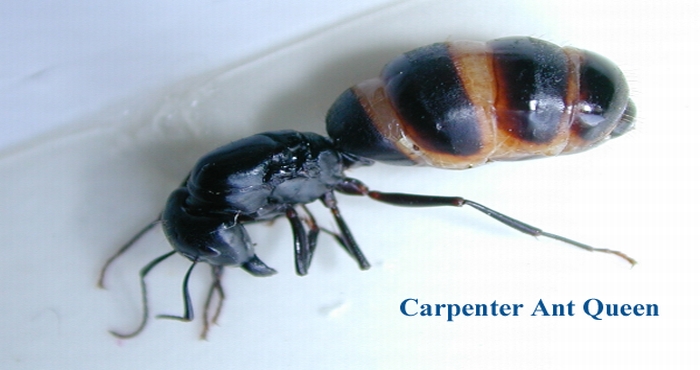
Carpenter Ant Queen
Carpenter Ant Queens can live for over 20 years. When she gets too old, the colony just selects one of the other large female reproductives to become the new queen. Most of the eggs in a carpenter ant colony are laid by the many female reproductives. Individually though, the queen being the largest, lays the most eggs. Note: The carpenter ant queen lives outside in a tree. When you find a very large winged carpenter ant inside your home it is not the queen, it is just one of many large female reproductives that have just swarmed from a nearby carpenter ant satellite colony (most likely from a nearby window, wall or sill area).
Sugar Ants – Pavement Ants
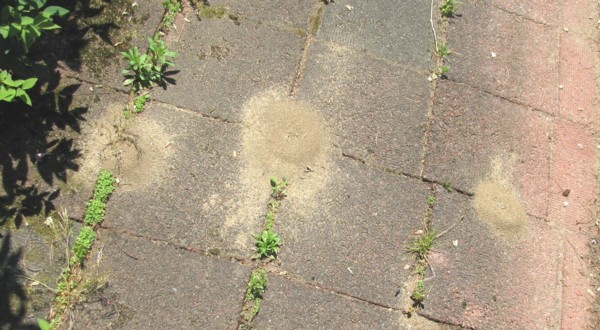
Sugar ants are light to dark brown with a reddish tint. They are the same ants as the ones above we’ve referred to as pavement ants. Appendages are usually lighter than the rest of the body. The size of the sugar ants within a colony will be very consistent averaging one-tenth of an inch, although the winged reproductives can be much larger. Sugar ants prefer sandy soil and usually live underground, but nests can also be found indoors in walls and under floors. Sugar ant colonies commonly number around 500,000 and can be a tremendous nuisance, invading buildings throughout the year, foraging for food. All it takes is for one sugar ant to find a piece of food, and in a short amount of time, the area will be covered by sugar ants. They accomplish this by laying down a pheromone trail from the food source to the colony. The sugar ants underground in the colony simply follow the chemical (pheromone) trail back to the food source. Sugar ants will feed on many things, but prefer greasy and or sweet foods. This attraction for sweets, has led pavement ants ( name used in the pest control trade), to be referred to as sugar ants by most homeowners. Sugar ants can be a particular nuisance in and around homes with slab-on-grade construction and any basement dwellings. Sugar ants are frequently seen trailing up the exterior foundations of homes. Also, since sugar ants live underground, entry into a home can even be obtained through hairline cracks in the foundation or basement floor, even in the middle of winter!
Call 800-362-2687
Towns We Perform Ant Control Services for in
Middlesex County Massachusetts
Burlington MA, Woburn MA, Winchester MA, Wilmington MA, Stoneham MA,
Acton MA, Boxborough MA, Carlisle MA, Concord MA, Westford MA,
Arlington MA, Lexington MA, Belmont MA, Cambridge MA, Somerville MA,
Newton MA, Newton Center MA, West Newton MA, Chestnut Hill MA,
Lowell MA, Tewksbury MA, Tyngsboro MA, Pepperell MA, Dunstable MA,
Waltham MA, Watertown MA, Weston MA, Wayland MA, Lincoln MA,
Framingham MA, Hopkinton MA, Natick MA, Holliston MA, Ashland MA,
Everett MA, Malden MA, Medford MA, Wakefield MA, Melrose MA,
Chelmsford MA, Hudson MA, Boxboro MA, Maynard MA, Stow MA, Ayer MA,
Brighton MA, Charlestown MA, West Cambridge MA, West Medford MA,
Littleton MA, Groton MA, Marlborough MA, Shirley MA, Ashby MA,
Dracut MA, Billerica MA, Bedford MA, Reading MA, North Reading MA
Towns We Perform Ant Control Services for in
Essex County Massachusetts
Beverly MA, Gloucester MA, Rockport MA, Essex MA, Manchester MA,
Salisbury MA, Byfield MA, Rowley MA, Georgetown MA, Groveland MA,
Danvers MA, Boxford MA, Hamilton MA, Ipswich MA, Topsfield MA,
Andover MA, Bradford MA, North Andover MA, Haverhill MA, Lawrence MA,
Marblehead MA, Salem MA, Swampscott MA, Nahant MA, Peabody MA,
Newburyport MA, Amesbury MA, Merrimac MA, Newbury MA, W.Newbury MA,
Saugus MA, Middleton, Andover MA, Lynnfield MA, Lynn MA, Methuen MA
Towns We Perform Ant Control Services in
Norfolk County Massachusetts
Quincy MA, Milton MA, Brookline MA, Dorchester MA, Hyde Park MA,
Walpole MA, Foxboro MA, Norwood MA, Needham MA, Wellesley MA,
Canton MA, Dedham MA, Dover MA, Stoughton MA, Sharon MA,
Franklin MA, Medfield MA, Medway MA, Millis MA, Norfolk MA
We Perform Ant Control Services to these Boston Area Towns
Boston MA, Roslindale MA, East Boston MA, Revere MA, Winthrop MA
Towns We Perform Ant Control Services in
Plymouth County Massachusetts
Scituate MA, Duxbury MA, Kingston MA, Rockland MA, E. Bridgewater MA,
Hingham MA, Norwell MA, Hull MA, Hanover MA, Carver MA, Pembroke MA,
Marshfield MA, Plymouth MA, Plympton MA, Halifax MA, Middleborough MA
Towns We Perform Ant Control Services in
Worcester County Massachusetts
Harvard MA, Bolton MA, Lunenburg MA, Clinton MA, Northborough MA,
Fitchburg MA, Leominster MA, Lancaster MA, Sterling MA, Berlin MA,
Southborough MA, Westboro MA, Grafton MA, Boylston MA, Upton MA,
Milford MA, Mendon MA, Hopedale MA, Millville MA, Blackstone MA,
Ashburn MA, Hubbardston MA, Westminster MA, West Boylston MA,
Douglas MA, Millbury MA, Northbridge MA, Sutton MA, Oxford MA,
Charlton MA, Dudley MA, Spencer MA, Uxbridge MA, Gardner MA
Don’t see your town listed? Please call to see if we service that area.
Do You See Mold in your Basement or Attic Ceiling?
AdVanced Mold Testing & Mold Remediation Services
https://www.mold-removal-remediation-testing-inspections-ma.com
Black Carpenter Ant Control in MA – Safe Fast Ant Elimination
https://security-pest-control-carpenter-ant-control-insect-control-ma.com/