

SECURITY SQUIRREL CONTROL
& Squirrel Removal Services
Serving Eastern Mass Since 1993
800-362-2687
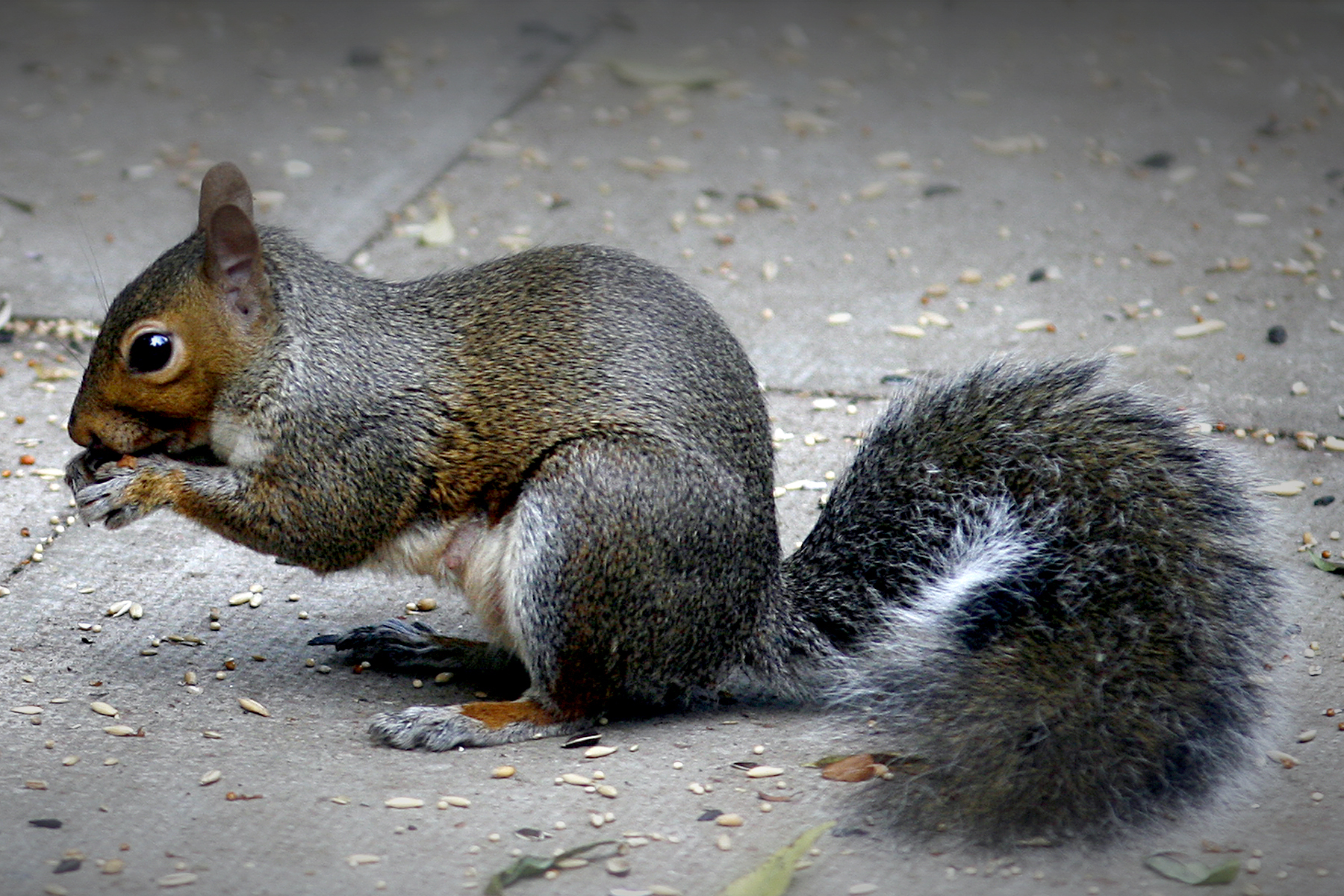
Eastern Grey Squirrel
EXPERT SQUIRREL CONTROL & WILDLIFE REMOVAL
We specialize in removing all types of problem squirrels from your residence. We regularly perform squirrel removal to difficult to access areas such as: inaccessible attics, eaves, cathedral ceilings and crawlspaces.
* We’re State Licensed Problem Animal Control Agents
* PAC Certified Squirrel Removal
* We Offer Extended Warranties Against Squirrel Re-Entry
Squirrel Removal in Massachusetts
Squirrel removal from the attic or eaves is the most common squirrel removal we do. Attics are ideal places for mother squirrels to make their nests, they’ll also nest in the cavities in your home’s walls. These cavities are accessed by the squirrels through the top of the wall openings in your attic. Squirrels will enter your home through existing holes or chew their way in through vents, soffits, gables or other wood damaged areas. The main problem with squirrels living in your house is the damage they cause.
Squirrels in the Attic
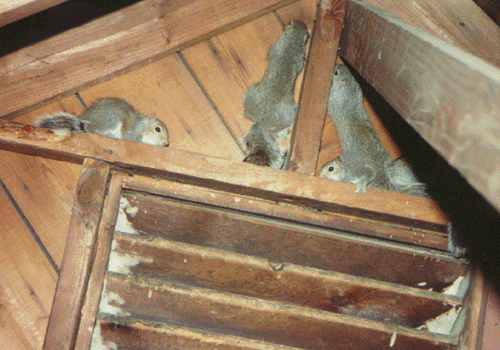
Grey Squirrels
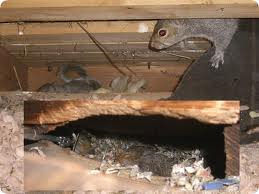
Nesting in Your Attic
How We Get Rid of Squirrels
- SQUIRREL EXCLUSIONS – The quickest way how to get rid of squirrels in an attic, or in an exterior wall is with the proper use of one-way squirrel doors. To exclude grey squirrels or red squirrels from your home, we like to use the one-way squirrel doors, whenever possible. This involves finding all the possible squirrel entry and exit holes the squirrels are using to gain access to your home. Then, we seal-up the openings they are not using and install one-way squirrel doors to the openings they are currently using. These temporary squirrel doors allow the squirrels to exit your home, but they can’t return. After the squirrels have all exited your home, we’ll return and remove the squirrel doors and do the final sealing-up. The final sealing-up should be done as quickly as possible to prevent new neighborhood squirrels from re-infesting your home.
Note: Using one-way squirrel doors is considered the best way to get rid of squirrels and eliminate an ongoing squirrel problem. This is our preferred method of squirrel removal, it’s faster than trapping and costs the customer less. - SQUIRREL TRAPPING – When installation of one-way squirrel doors is not possible, we will live trap the gray squirrels and remove them. After the squirrel problem is solved, we will seal-up the holes the squirrels chewed to gain access to your home. We also perform wildlife removal for other problem animals such as; Flying Squirrels, Woodchuck Removal, Raccoon Trapping, Opossum Trapping and Groundhog Removal.
Signs of Grey Squirrels in Your Home
Grey squirrels are the most common squirrels we see outside in our yards. They come out early in the morning and are active throughout the day. The most common symptoms of a gray squirrel infestation are loud chewing and scratching sounds in walls and ceilings just before dark and again in the early morning hours. Since they weigh up to a couple pounds their chewing and scratching sounds will be much louder than a small rodent could make. When heard running across an overhead ceiling – you will know it’s from a larger animal. Grey squirrels are very destructive. They can chew large holes through wood and often chew through electrical wiring insulation.
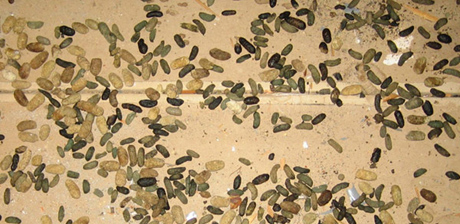
Grey Squirrel Droppings
Click Here to Compare
Squirrel Droppings to Mice Droppings
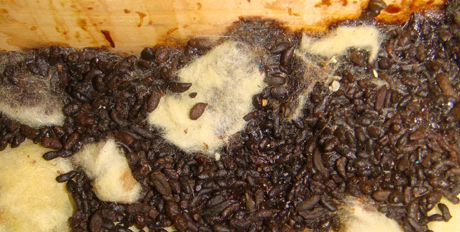
Flying Squirrel Droppings
Common Signs of Squirrel Activity in Your Home
- Chewed wiring in attic and wall voids
- Damage to vent louvers and vent screening
- Bad odor from feces and urine-soaked insulation
- Soffit, gable & roof damage from squirrel chewing
- Stains on ceilings from squirrel urine
- Feces and urine deposits
Flying Squirrels in Your Attic
Flying squirrels look a lot like baby grey squirrels. The most noticeable differences is the webbing between their legs and body and the fur on the tail is more flattened instead of round and fluffy like on the much larger grey squirrel.
Unlike grey squirrels, flying squirrels sleep during the day and are active at night. They can get into very small roof openings. They also tend to travel in groups. Like grey squirrels they like to chew on many items. Flying squirrels may sound like mice in your walls or you may here them moving around at night above your bedroom ceilings. They can access your roof by jumping off tall trees and landing on your roof. Our pest control technicians are very experienced at removal of flying squirrels from attics.
Grey Squirrels are Excellent Jumpers
Grey squirrels can easily jump from tree branches to our homes. They have been know to jump more than 6 feet across. They can even cover more distance if they are jumping down to a lower object. They are great climbers. They can run up along a drain pipe from the ground to the roofline in just a couple seconds.
Squirrel Damage to our Homes
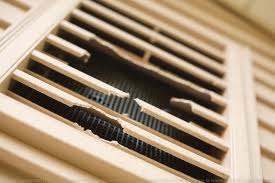
Squirrel Damage to Attic Vent Louvers
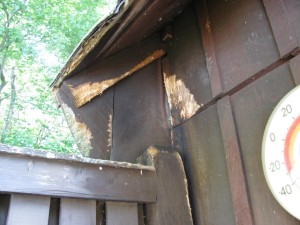
Squirrel damage to fence and shed
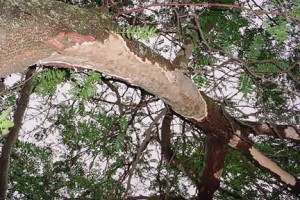
Gray squirrel damage to tree branch
Squirrel Damage Causing Fires & Power Outages
A Lack of Squirrel Control in the Attic Means Wire Damage, House Fires and Power Outages According to the US Fire Administration there are usually about 120,000 residential fires of “unknown cause” each year in the US. Since 25% of house fires of “unknown cause” are attributed to squirrels and other rodents chewing on wiring, that’s possibly up to 30,000 house fires each year in the U.S. as a result of inadequate squirrel control, mice control, or rat control. If you have rodents, such as squirrels or mice, in your attic – you probably have wire damage too. Squirrels are often the cause of power outages. They can readily climb a power pole and crawl across a power line. If they touch a high voltage conductor and a grounded portion of the device at the same time, they are then electrocuted and cause a short circuit that shuts down equipment. Squirrels have brought down the New York Stock market twice. To sharpen their teeth they will often chew on tree branches or even the occasional live power line. City officials of New York City attribute at least one power outage each day to squirrels. Squirrels cause more power outages than lightning in some states. In Georgia in 2006 there were 16,520 power outages caused by squirrels. Not all of these outages were caused by the squirrels chewing on the wires – some were just contact electrocutions, but many were from contact with the metal wire after the squirrel chewed through the wire’s insulation and the squirrel was electrocuted.
Why Squirrels Chew Wires
Squirrels like to chew on various edible and inedible objects. This characteristic aids in maintaining sharp teeth and because their teeth grow continuously ( 6 inches per year ), prevents over-growth. Squirrels have 22 teeth. They will chew on just about anything. Grey squirrels even grind their teeth in their sleep. Rodents, such as Squirrels, Rats and Mice have to chew and gnaw constantly to keep their teeth’s length in check otherwise their teeth would grow too long – rendering them unable to eat and thus starve to death.
Damage to wires in attic caused by squirrels chewing
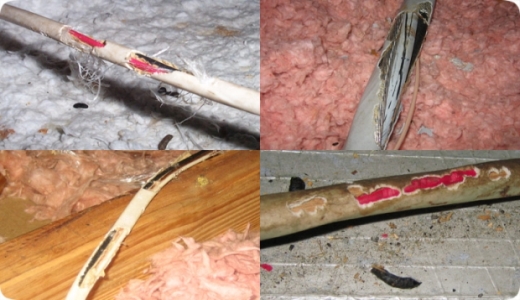
Chewed wires from grey squirrels
Squirrel Habits and Info
A squirrel is in the family Sciuridae. This family also includes ground squirrels, flying squirrels, chipmunks and woodchucks. The average gray squirrel lives for 3-5 years. Squirrels are clever and persistent animals. They are notorious for eating out of bird feeders. They also dig-up flower beds to pull out bulbs. Squirrels have a keen sense of smell which they use to locate buried nuts and can dig extensive holes in the ground through-out their area. Crows, look for squirrels burying nuts, so they can dig them up as soon as the squirrel leaves. Squirrels are expert tree climbers, but can also survive quiet happily in urban areas devoid of trees. They have scent glands in their feet. When they move around they leave scent trails for other squirrels to follow. Their pheromones last up to two years. Grey squirrels love to live in attics. Attics are warmer, drier and safer from predators than outside tree nests. Since they are incontinent – they will just urinate and defecate all over the attic and wall voids. Grey squirrels leave behind large raisin sized droppings all over the place and urine stained, ripped and or, matted down insulation that smells of urine.
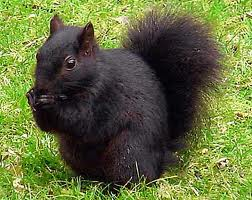
These are both grey squirrels
The black color is just a seasonal change that occurs in some grey squirrels.

Squirrel Facts:
- A squirrel has a brain about the size of a walnut.
- Squirrels communicate with each other through different chirps.
- Squirrels can run fast. Squirrels can run up to a speed of about twenty miles per hour.
- Squirrels eat up to 2 pounds of food each week. A squirrel’s diet consists of nuts, acorns, birdseed, bird eggs, mushrooms, corn, wheat, insects, garbage, and berries.
- Squirrels scent mark their food before they hide it for the winter.
- Squirrels have double-jointed hind legs. This aids squirrels in their ability to run up and down trees quickly.
- A squirrel can fall up to 70 feet without injury.
- Squirrels have 4 toes on their front feet. The nails on their front feet are very sharp which helps them hold onto surfaces they are climbing.
- Squirrels have 5 toes on their back feet.
- The Eastern Grey Squirrel can also be found in Western states as well as in The United Kingdom.
- A male squirrel can detect from smell, a female squirrel in heat a mile away.
- Squirrels can jump a distance of approximately 19 feet.
- Squirrels have eyes on the sides of their head, which allows them to see behind themselves.
Squirrels will clean nuts before they burying them. The squirrel will crack the nut open and then lick the nut and rub it on its face to clean it. This marks the buried nut with the squirrel’s scent to make it easier for the squirrel to find later. Grey squirrels can find a nut even under a foot of snow. They will carry their nuts from outside and stash them inside you walls and or, attic area.
Foods like peanuts in shells that people might throw outside will also get carried inside by grey squirrels. Squirrels can have parasites and fleas. If their nest becomes infested they will just move to a new nest. To prevent fire hazards, squirrel feces and urine damaged insulation and food being hidden in your walls ( this leads to other pest problems ) it’s so important to get rid of squirrels in the attic.
Squirrel Control Techniques That Fall Short:
Squirrel Control by means of wolf urine, coyote urine, fox urine, or scents? Do you think these so-called squirrel repellents will get rid of squirrels in in your walls or attic? Pest professionals say they do not work? We’ve tried most of them. The squirrels either ignored the smell or sometimes just moved to another area in the house. This method also left a foul urine smell in the attic for quite awhile. Will playing a radio get rid of squirrels in the attic? This sometimes works for a day or two, but that’s about it. They simply get used to it, just like people get used to sleeping with a radio on.
Squirrel Control using Moth Balls in the attic is illegal and toxic to humans.Mothballs are toxic to people and pets. Mothballs are made from naphthalene. Naphalene is derived from coal tar. Since the naphalene gas emitted from the mothballs is heavier than air it will find its way down into the upper living areas of your house. Also, mothballs take oxygen out of the air. Mothballs might work for a while, but the amount of mothballs needed to force the gray squirrels out of your attic will make your attic and upper levels of your house smell like mothballs for years. Lastly, the squirrels will usually just move their nest to another part of your house, like an isolated wall void or between your floors.
Moth Balls Problems:
- Headaches, nausea, dizziness
- Cancer – mothballs are possible carcinogens
- Effect on babies- skin rash, anemia, jaundice
- Breathing difficulties – asthma attacks, asthma worsening
Rat Traps Used for Squirrel Control
Rat traps are designed for rats – not for squirrels! If you use a rat trap as a squirrel trap the squirrel will just get wounded and possibly die later somewhere in your house. If this spot is inaccessible, you now have bigger problems.
Squirrel Control using ultrasonic repellent devices?
Experts in the field have tried to get the Federal Trade Commission to ban ultrasonic pest control devices for squirrel and rodent control, because of poor field results. The Federal Trade Commission has published a warning to all ultrasonic pest repeller manufacturers & retailers (www.ftc.gov/opa/2001/05/fyi0128.shtm). Pests may initially move away from the device, but research shows that the pests return and become habituated (get used to the sound). Research shows that the repelling effect lasts for 1-3 days, but 4-8 days later they get used to the noise and continue living in your home. Most researchers urge consumers to view ultrasonic pest repellents with skepticism. The New York State Consumer Protection Board cautions against using ultrasonic repellers.
Note: There is scientific evidence that some of these devices can cause hearing loss in animals, especially dogs.
800-362-2687
Middlesex County MA Towns We Perform Squirrel Removal & Trapping Services
Acton MA, Boxborough MA, Carlisle MA, Concord MA, Westford MA,
Arlington MA, Lexington MA, Belmont MA, Cambridge MA, Somerville MA,
Newton MA, Newton Center MA, West Newton MA, Chestnut Hill MA,
Lowell MA, Tewksbury MA, Tyngsboro MA, Pepperell MA, Dunstable MA,
Waltham MA, Watertown MA, Weston MA, Wayland MA, Lincoln MA,
Framingham MA, Hopkinton MA, Natick MA, Holliston MA, Ashland MA,
Everett MA, Malden MA, Medford MA, Wakefield MA, Melrose MA,
Chelmsford MA, Hudson MA, Boxboro MA, Maynard MA, Stow MA, Ayer MA,
Brighton MA, Charlestown MA, West Cambridge MA, West Medford MA,
Littleton MA, Groton MA, Marlborough MA, Shirley MA, Ashby MA,
Dracut MA, Billerica MA, Bedford MA, Reading MA, North Reading MA
Essex County MA Towns We Perform Squirrel Control Services
Salisbury MA, Byfield MA, Rowley MA, Georgetown MA, Groveland MA,
Danvers MA, Boxford MA, Hamilton MA, Ipswich MA, Topsfield MA,
Andover MA, Bradford MA, North Andover MA, Haverhill MA, Lawrence MA,
Marblehead MA, Salem MA, Swampscott MA, Nahant MA, Peabody MA,
Newburyport MA, Amesbury MA, Merrimac MA, Newbury MA, W.Newbury MA,
Saugus MA, Middleton, Andover MA, Lynnfield MA, Lynn MA, Methuen MA
Norfolk County MA Towns We Service for Squirrel Removal & Squirrel Exclusions
Quincy MA, Milton MA, Brookline MA, Dorchester MA, Hyde Park MA,
Walpole MA, Foxboro MA, Norwood MA, Needham MA, Wellesley MA,
Canton MA, Dedham MA, Dover MA, Stoughton MA, Sharon MA,
Franklin MA, Medfield MA, Medway MA, Millis MA, Norfolk MA
Boston Area in Suffolk County MA Towns We Service for Squirrel Trapping Services
Boston MA, Roslindale MA, East Boston MA, Revere MA, Winthrop MA
Plymouth County MA Towns We Service Towns We Service for Squirrel Exclusions & Trapping
Scituate MA, Duxbury MA, Kingston MA, Rockland MA, E. Bridgewater MA,
Hingham MA, Norwell MA, Hull MA, Hanover MA, Carver MA, Pembroke MA,
Marshfield MA, Plymouth MA, Plympton MA, Halifax MA, Middleborough MA
Worcester County MA Towns We Service Towns We Service for Squirrel Exclusions
Harvard MA, Bolton MA, Lunenburg MA, Clinton MA, Northborough MA,
Fitchburg MA, Leominster MA, Lancaster MA, Sterling MA, Berlin MA,
Southborough MA, Westboro MA, Grafton MA, Boylston MA, Upton MA,
Milford MA, Mendon MA, Hopedale MA, Millville MA, Blackstone MA,
Ashburn MA, Hubbardston MA, Westminster MA, West Boylston MA,
Douglas MA, Millbury MA, Northbridge MA, Sutton MA, Oxford MA,
Charlton MA, Dudley MA, Spencer MA, Uxbridge MA, Gardner MA
Don’t see your town listed? Please call to see if we service that area.
Massachusetts Wildlife Removal
Expert Squirrel Trapping and Bat Removal Services
securitypest.com/wildlife-raccoon-trapping-squirrel-control-bat-removal-ma.htm
Do You See Mold in your Basement or Attic Ceiling?
AdVanced Mold Testing & Mold Remediation Services
http://www.mold-removal-remediation-testing-inspections-ma.com/index.htm
