
Massachusetts Carpenter Ant Specialists
Carpenter Ants
Security Pest Elimination has been treating carpenter ants across Eastern Massachusetts since 1993. Our low-odor, low-toxicity treatment eliminates the carpenter ants you are seeing and the hidden nests in your walls — which is where the real damage is happening.
Massachusetts Carpenter Ant Specialists
Carpenter Ant Treatments, Colony Elimination
For carpenter ant control we use a low-odor, low-toxicity treatment to prevent or eliminate carpenter ant infestations. Our carpenter ant treatment not only eliminates the carpenter ants you are seeing, it also eliminates the hidden carpenter ant nests in your walls. This is where the real damage is occurring.
*To best prevent a carpenter ant re-infestation, a carpenter ant treatment should be done on an annual basis before May 20th. After the middle of May, homes that are located within the 300 ft. range of an outside carpenter ant colony might already be re-infested. This is because the carpenter ant workers might have already hollowed out some new wood in your home to move the newly developing larvae into. Besides individual carpenter ant treatments, we offer annual service plans that schedule their spring-time preventative treatments before this important date.
The Problem
Carpenter Ants Hollow Out Your Home From the Inside
The most susceptible areas of your home are where decks connect to the house, window sills, corner exterior sections and under doorways — though carpenter ants can turn up almost anywhere. Once inside, they travel along water pipes and build satellite colonies in walls and upper floors, going undetected until the nest reaches maturity.
Carpenter ants do not eat wood. They rip it apart with their mandibles to nest, cutting galleries with the grain and leaving a clean, sandpapered surface. If you live within 300 feet of an outside nest, your home is under siege every year, which is why timely annual preventative treatment matters.
Warning Signs to Watch For
Frass
Sawdust or wood shavings piled near sills, decks or baseboards.
Winged swarmers
Large winged ants indoors mean a mature nest, not a passing visitor.
Spring surge
Hundreds of ants pouring out on the first warm day of spring.
Trails at entry points
Ants where decks meet the house, at window sills and doorways.
Water-damaged wood
Moisture-damaged timber is a prime target for a new nest.
How It Works
Our Carpenter Ant Treatment Process
01
Free Inspection & Nest Detection
A licensed technician inspects for carpenter ant activity, locating the main nest, the hidden satellite nests in your walls, and the entry points and water-damaged wood feeding them.
02
Targeted Nest Treatment
A low-odor, low-toxicity application is placed where the ants actually are, reaching the satellite nests inside walls and upper floors rather than only the foragers you can see.
03
Moisture Control & Annual Protection
We point out the moisture and water-damaged wood that draw ants back, and schedule the spring preventative treatment before May 20th that stops a neighboring colony from moving in.
Insect Information
Carpenter Ant Facts
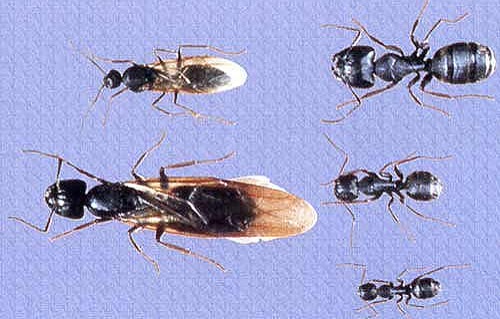
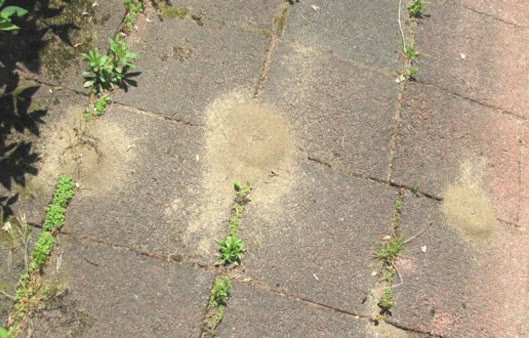
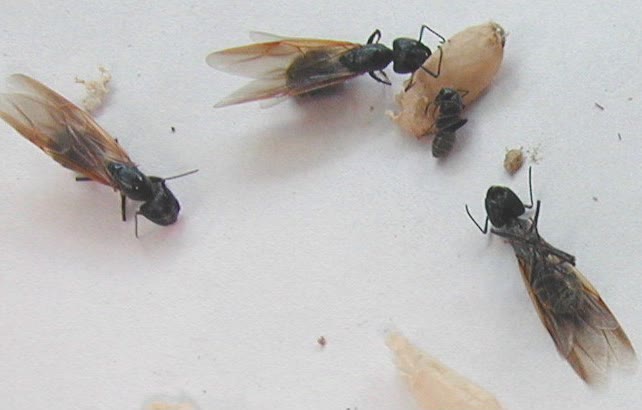
Minor workers run 1/4 to 1/2 inch long
Major workers reach 1/2 to 3/4 inch
Winged reproductives grow up to 1 inch
Carpenter ants excavate wood, they do not eat it
An outside nest can hold around 30,000 ants
Satellite nests indoors reach about 3,000 workers
A carpenter ant queen can live over 20 years
Sugar ant colonies commonly number around 500,000
Carpenter Ants
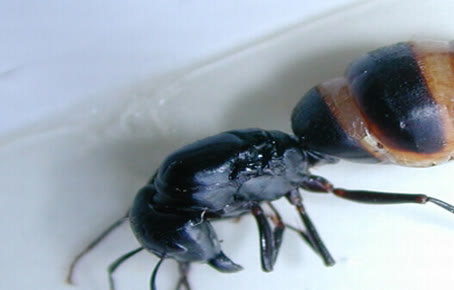
The most common ant in the New England area which causes home owners to seek professional help is the carpenter ant (Camponotus spp.). They are the most noticeable of ants in and around the home, being large and usually blackish, perhaps with some faintly grayish bands on the abdomen. Other carpenter ants may have some reddish or purplish coloration to the thorax. Foraging workers have large mandibles which can give a powerful bite.
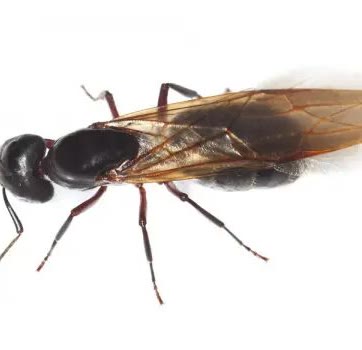
They vary greatly in size depending on their function, from 1/4 to 1/2 inch minor workers, 1/2 to 3/4 inch major workers and 3/4 to 1 inch long winged reproductives. Most carpenter ants seen inside your home are the wingless minor workers that make up most of the colony. Galleries are cut with the wood grain and major workers then carry the developing larvae from the outside nest, around 30,000 ants, to the new satellite colonies in nearby homes. These secondary nests can have up to 3,000 workers.
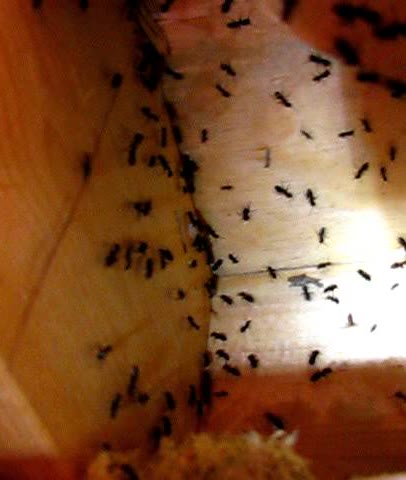
Large Carpenter Ant Colony We Found in a Customer’s House
Carpenter Ant Damage
Carpenter ants can cause serious damage to wood by excavating galleries, which somewhat resembles the work of termites but can be distinguished by their very clean, sandpapered appearance. Sawdust or wood shavings known as frass found in and around the home is usually an indication of a nest being excavated nearby, but very often it goes unnoticed because the wood shavings are being deposited inside your walls.
Once inside the home, ants can quickly travel along water pipes and create satellite colonies in walls and upper levels, going undetected until the nest reaches maturity. When this happens, not only is wood being destroyed, but on the first warm day in spring the nest blossoms and hundreds of ants can come pouring out into your home. Seeing winged swarmers is a definite sign of a nest, because carpenter ant swarmers do not forage for food — they leave a mature nest only to mate and start a new colony.
Carpenter Ant Queen
Carpenter ant queens can live for over 20 years. When she gets too old, the colony just selects one of the other large female reproductives to become the new queen. Most of the eggs in a carpenter ant colony are laid by the many female reproductives; individually though, the queen being the largest lays the most eggs.
The carpenter ant queen lives outside in a tree. When you find a very large winged carpenter ant inside your home it is not the queen — it is just one of many large female reproductives that have swarmed from a nearby carpenter ant satellite colony, most likely from a nearby window, wall or sill area.
Sugar Ants – Pavement Ants
Sugar ants are light to dark brown with a reddish tint, and are the same ants known in the trade as pavement ants. The size of the sugar ants within a colony is very consistent, averaging one-tenth of an inch, although the winged reproductives can be much larger. They prefer sandy soil and usually live underground, but nests can also be found indoors in walls and under floors. Sugar ant colonies commonly number around 500,000.
All it takes is for one sugar ant to find a piece of food and in a short amount of time the area will be covered, because they lay down a pheromone trail from the food source back to the colony. Sugar ants will feed on many things but prefer greasy and sweet foods. They can be a particular nuisance around homes with slab-on-grade construction and basement dwellings, and can enter through hairline cracks in the foundation or basement floor, even in the middle of winter.
Common Questions
Carpenter Ant FAQs
No. Carpenter ants excavate wood to nest in it rather than eating it, ripping it apart with their mandibles and pushing the shavings out as frass. The galleries they cut follow the wood grain and have a clean, sandpapered look, which is how we tell their damage from termite damage.
Regularly seeing carpenter ants inside is a good indication there is a nest in the wood structure nearby. Winged swarmers indoors are a definite sign, because swarmers do not forage for food — they leave a mature nest only to mate and start a new colony.
After the middle of May, homes within 300 feet of an outside colony may already be re-infested, because the workers will have hollowed out new wood to move their developing larvae into. Treating before that date means the first scouts die and the colony does not select your home for a satellite nest that year.
We use a low-odor, low-toxicity treatment for carpenter ant control. It is applied to the areas the ants are nesting in and travelling along rather than broadcast through your living space.
Carpenter ants are large and usually blackish, from a quarter inch up to an inch for winged reproductives, and they damage wood. Sugar ants — pavement ants — are small and consistently about a tenth of an inch, brown with a reddish tint, and nest in soil. They do not damage wood, but they invade in huge numbers looking for greasy and sweet food.
Service Area
Towns We Perform Ant Control Services In
- Acton, MA
- Arlington, MA
- Ashby, MA
- Ashland, MA
- Ayer, MA
- Bedford, MA
- Belmont, MA
- Billerica, MA
- Boxborough, MA
- Burlington, MA
- Cambridge, MA
- Carlisle, MA
- Chelmsford, MA
- Chestnut Hill, MA
- Concord, MA
- Dracut, MA
- Dunstable, MA
- Everett, MA
- Framingham, MA
- Groton, MA
- Holliston, MA
- Hopkinton, MA
- Hudson, MA
- Lexington, MA
- Lincoln, MA
- Littleton, MA
- Lowell, MA
- Malden, MA
- Marlborough, MA
- Maynard, MA
- Medford, MA
- Melrose, MA
- Natick, MA
- Newton, MA
- Newton Center, MA
- North Reading, MA
- Pepperell, MA
- Reading, MA
- Sherborn, MA
- Shirley, MA
- Somerville, MA
- Stoneham, MA
- Stow, MA
- Sudbury, MA
- Tewksbury, MA
- Tyngsborough, MA
- Wakefield, MA
- Waltham, MA
- Watertown, MA
- Wayland, MA
- West Cambridge, MA
- Westford, MA
- West Medford, MA
- West Newton, MA
- Weston, MA
- Wilmington, MA
- Winchester, MA
- Woburn, MA
- Amesbury, MA
- Andover, MA
- Beverly, MA
- Boxford, MA
- Bradford, MA
- Byfield, MA
- Danvers, MA
- Essex, MA
- Georgetown, MA
- Gloucester, MA
- Groveland, MA
- Hamilton, MA
- Haverhill, MA
- Ipswich, MA
- Lawrence, MA
- Lynn, MA
- Lynnfield, MA
- Magnolia, MA
- Manchester-by-the-Sea, MA
- Marblehead, MA
- Merrimac, MA
- Methuen, MA
- Middleton, MA
- Nahant, MA
- Newbury, MA
- Newburyport, MA
- North Andover, MA
- Peabody, MA
- Rockport, MA
- Rowley, MA
- Salem, MA
- Salisbury, MA
- Saugus, MA
- Swampscott, MA
- Topsfield, MA
- West Newbury, MA
- Avon, MA
- Braintree, MA
- Brookline, MA
- Canton, MA
- Cohasset, MA
- Dedham, MA
- Dover, MA
- Foxborough, MA
- Franklin, MA
- Holbrook, MA
- Medfield, MA
- Medway, MA
- Millis, MA
- Milton, MA
- Needham, MA
- Norfolk, MA
- Norwood, MA
- Quincy, MA
- Randolph, MA
- Sharon, MA
- Stoughton, MA
- Walpole, MA
- Wellesley, MA
- Westwood, MA
- Weymouth, MA
- Ashburnham, MA
- Auburn, MA
- Berlin, MA
- Blackstone, MA
- Bolton, MA
- Boylston, MA
- Charlton, MA
- Clinton, MA
- Douglas, MA
- Dudley, MA
- Fitchburg, MA
- Gardner, MA
- Grafton, MA
- Harvard, MA
- Hopedale, MA
- Hubbardston, MA
- Lancaster, MA
- Leominster, MA
- Lunenburg, MA
- Mendon, MA
- Milford, MA
- Millbury, MA
- Millville, MA
- Northborough, MA
- Northbridge, MA
- Oxford, MA
- Paxton, MA
- Princeton, MA
- Shrewsbury, MA
- Southborough, MA
- Spencer, MA
- Sterling, MA
- Sutton, MA
- Upton, MA
- Uxbridge, MA
- Westborough, MA
- West Boylston, MA
- Westminster, MA
- Worcester, MA
Don’t see your town listed? Please call to see if we service that area.